AI only where it works

Could One Message Breach Your AI Agent?

Prompt injection is what happens when an AI agent treats untrusted input as trusted instructions. We redesign the workflow so a malicious message can no longer trigger a privileged action.

Every engagement starts with a focused one-time analysis that turns your submitted problem into an implementation-ready plan, including workflow design, control points, boundary decisions, and rollout path.

The problem

Prompt injection: why the model is not a security boundary

Prompt injection succeeds when an AI system is allowed to treat untrusted content as instructions and turn its own interpretation into authority. The failure lies in a permissive workflow and must be fixed with better architecture.

1

Untrusted content shares a context with trusted instructions, credentials, and internal data.

2

The model can choose from broad tools, turning a persuasive message into a privileged action.

3

Sensitive actions have no deterministic policy check or human approval gate before execution.

Prompt injection is not a theoretical risk

These incidents look different on the surface, but the failure mode is the same: the model was allowed to speak or act as if it were the final authority. Real-world failures already show that conversational interfaces and agentic workflows can create legal, financial, and security exposure when they are not bounded properly.

GitHub logo GitHub

A public issue reached private repositories

Researchers showed that a public GitHub Issue could inject instructions into an agentic workflow that still had standing access to private repositories.

A public input channel was able to trigger private data exposure because the harness mixed untrusted instructions with privileged access.

Chevrolet logo Chevrolet

A dealership chatbot offered a Tahoe for $1

Chevrolet of Watsonville's chatbot was manipulated into agreeing with a crafted customer message and presenting a one-dollar vehicle offer as if it were binding.

The model was treated like the final commercial voice of the business instead of a bounded draft assistant.

Air Canada logo Air Canada

An invented refund policy created liability

Air Canada's chatbot invented a refund policy for when a passenger's family member dies, and the airline was later ordered to honor the resulting loss.

The system published unsupported policy guidance without a hard control layer or authoritative validation step.

Logos shown for illustrative reference only. All trademarks and brand assets remain the property of their respective owners.

Architecture

Fix the harness. Don't trust the model.

The control belongs around the model. Separate untrusted input from trusted instructions, scope every tool, and make policy checks and approval gates part of the execution path.

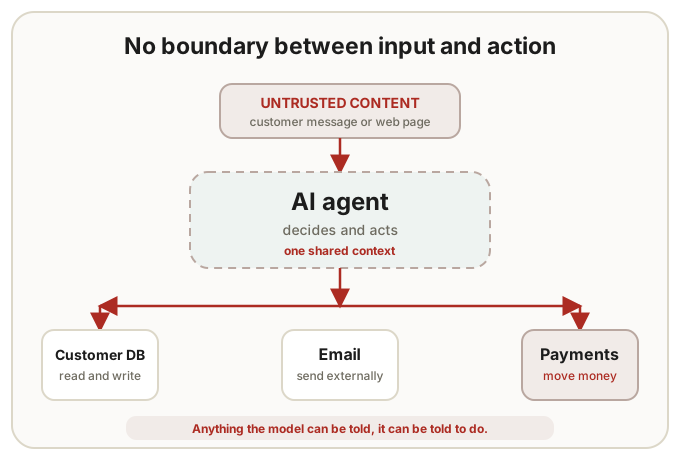
Bad No input boundary
Diagram showing untrusted input flowing directly into agent context with full tool access and no boundary
Untrusted input flows straight into the agent's context. With full tool access and no allowlist, any injected instruction can trigger a privileged action.
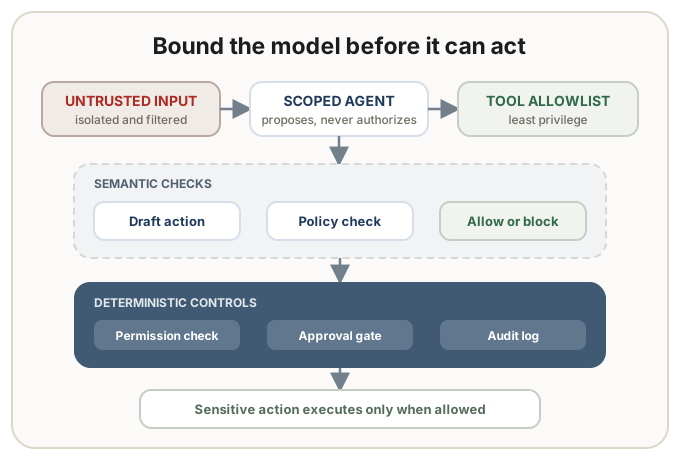
Good Scoped agent workflow
Diagram showing an input sanitizer, scoped agent, least-privilege tools, policy check, and human review before any action
Input is sanitized before it reaches the agent, tools are scoped to least privilege, and a policy check with human review sits in front of risky actions.

Our promise

Ship agents that can read untrusted content safely

We redesign the workflow so the model can help interpret information without becoming the final authority over data or actions.

Dedicated QA and policy-check agents between generation and action
Strict tool scoping instead of broad standing permissions
Separate handling for untrusted input, trusted instructions, and protected systems
Human approval on actions that can move money, expose data, or change systems

The process

From problem to implementation-ready plan in seven days

This $2,000 one-time engagement focuses on one important workflow problem, then gives your team a clear path to the next step: addressing the root cause and implementing the right changes.

01

Discovery

We document the current process, constraints, stakeholders, and the points where the workflow currently breaks.

02

Analysis

We audit the systems, data access, review points, and integration requirements the workflow will need in production.

03

Plan

You get a reviewable implementation blueprint covering workflow logic, models, systems, and human oversight.

After the analysis, we can implement the workflow end to end and maintain it, or stay on as your ongoing AI workflow consulting partner. Implementations start from $4,000.

Continuous support

We can support you as long as needed

Whether you need recurring advice on AI workflows, models and vendors, or want us to implement and then maintain your AI workflows, we have a suitable package for each case:

Consulting retainer

from $2,000 /month

No implementation required

For teams building it themselves who want an experienced second opinion on the architecture, the vendors, and the trade-offs before they commit to them.

  • Monthly strategy and architecture reviews
  • Model, vendor, and tooling decisions
  • Team training and AI education sessions

Implementation maintenance

from $1,000 /month

+ token usage at cost

For workflows we built for you. A live AI workflow needs ongoing maintenance: models change, integrations drift, and edge cases arrive. We keep it working.

  • Monitoring, alerting, and incident response
  • Keeping pace with changes to models, vendors, and pricing
  • Integration maintenance and updates as your AI systems evolve

Tell us about your workflow problem

Request an analysis

$2,000 one-time

Bring us one problem. It might be a manual process you want to automate, or an AI workflow already in production that feels unreliable, unsafe, or held together with tape. We spend seven days on it and hand back an implementation-ready plan: what the workflow should do, where the controls belong, and what it costs to build and run.

If the plan convinces you, we can build it.

What you get

  • A structured intake of the problem, the systems involved, and the constraints
  • An audit of the data, integrations, and review steps the workflow depends on
  • A workflow architecture with the control points, boundaries, and human oversight
  • A projected cost to build it and to run it
  • Delivered in 7 business days

Initial Consultation · one-time · 7 days · $2000

Solve your Problem Now

Describe the workflow and where it breaks today. We read every submission ourselves, and if it is a problem we can solve, we send back a short questionnaire and a payment link to start the seven days.