 ZebraZones

Hackers strike again
Three weeks ago, French supermarkets, including Intermarché, Carrefour, Leclerc and Monoprix, were struck by a nationwide attack. It turned on the defrost cycle and heated the freezer contents to 50 degrees for hours, spoiling frozen goods.
We covered that attack in How Hackers Heated Hundreds of French Freezers.
The second wave: Belgium, Sweden and Estonia
Today we are seeing the next wave of the same attack. Supermarkets across Europe seem affected: Delhaize, Carrefour and Spar in Belgium, ICA and Coop in Sweden, and Selver in Estonia.
The underlying reason is the same: fridge controllers are exposed to the open internet without additional protection. AI agents make it possible to exploit their known vulnerabilities at scale.
Prevention: secure architecture
How can this class of attack be prevented without a costly replacement of the controllers? Secure architecture.
All controllers must be connected to an internal network that acts as a shield, protecting the aging controllers from direct external access. Attacks carried out by AI agents will continue to raise the bar that every internet-connected system needs to clear.
Let's look at what that means in practice.
What insecure looks like
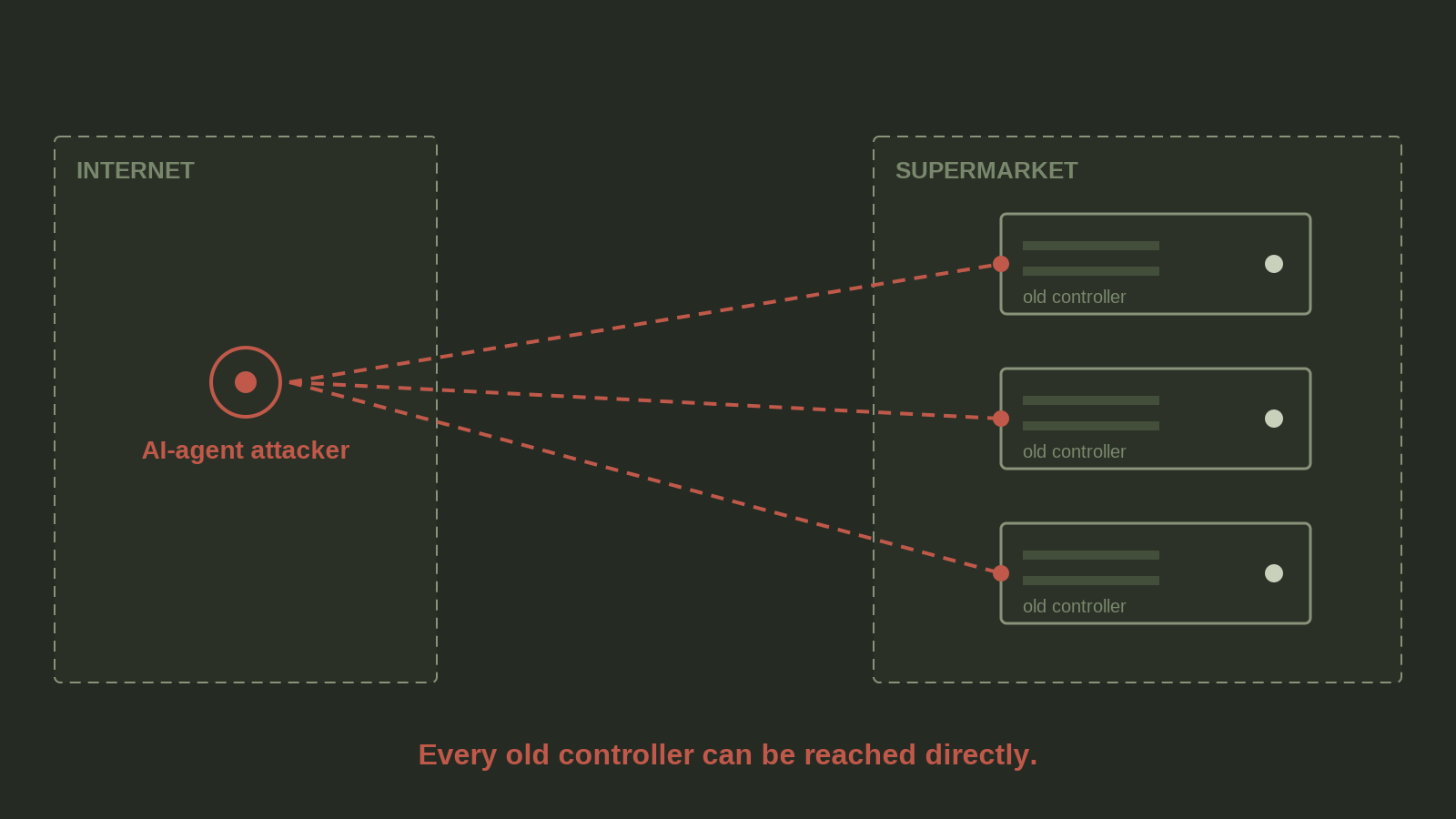
In the insecure setup, every controller in every store can be reached from the open internet. The controllers are old. Their firmware has known flaws, and their logins are weak by today's standards.
That was acceptable when finding such a device took a skilled person days of manual searching. It is not acceptable now. An AI agent can scan for exposed controllers, match each one against known vulnerabilities and attack all of them in parallel. Every device is its own front door, and every front door gets tested.
Old devices are normal
Controllers like these stay in service for many years. Many are past end of life, and many use authentication that is no longer considered durable. Replacing them is slow and costly, so they will remain in operation.
Security therefore cannot depend on the protection of each individual device. It depends on the architecture: devices are guarded by internal networks and access gateways, so that an attacker cannot reach them directly.
What secure looks like
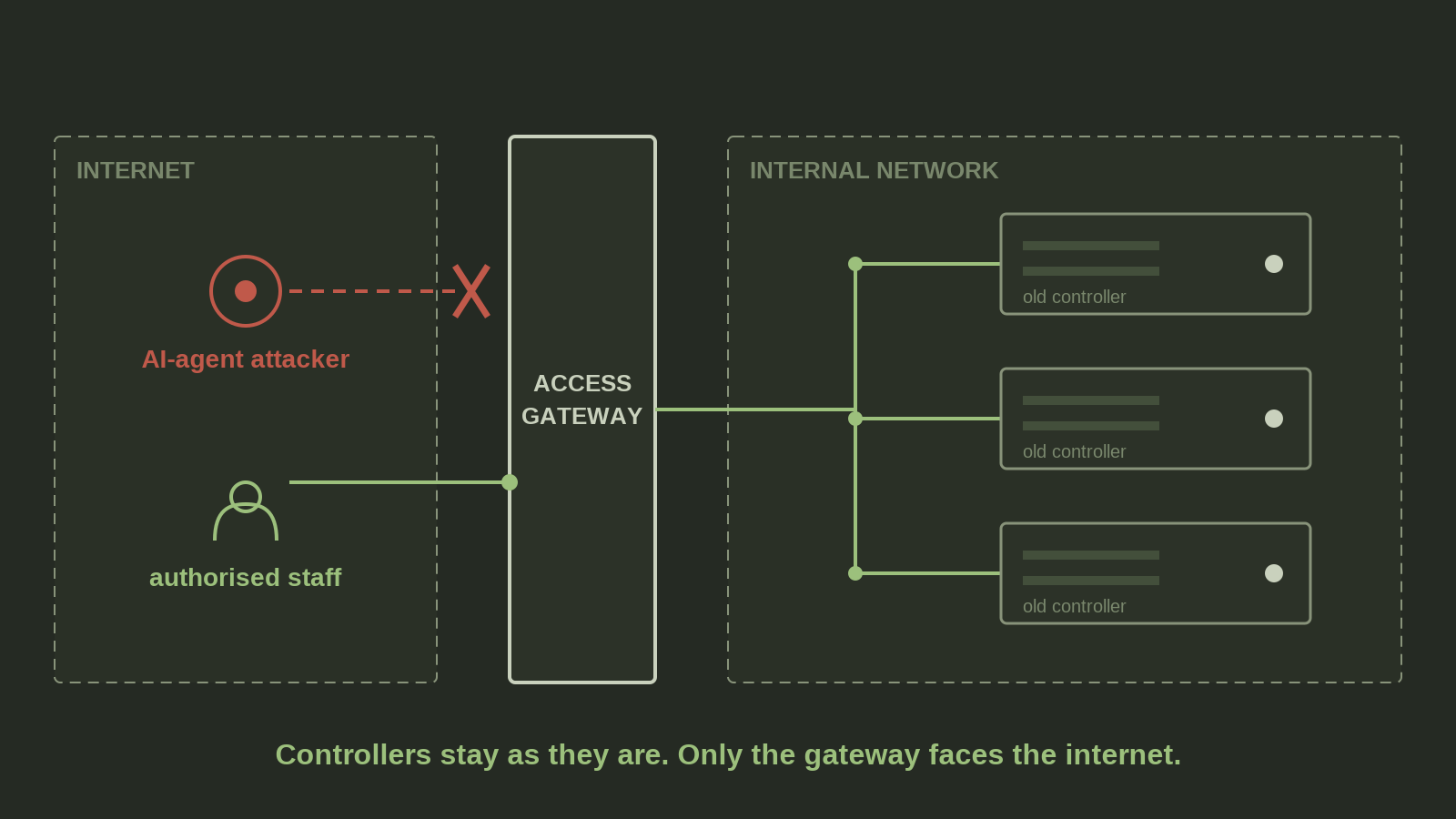
In the secure setup, the same controllers stay exactly where they are. What changes is the architecture around them.
The controllers sit in an internal network that has no route from the open internet. The only way in is an access gateway. The gateway requires a login, accepts connections only from approved sources and records every access. Authorised staff and service providers pass through it. An attacker on the internet reaches the gateway at most, and stops there.
This gives you three things:
- A small surface. Instead of hundreds of exposed controllers across all stores, there is one hardened entry point per site that you can monitor and keep up to date.
- Protection for devices you cannot fix. An unpatched controller that nobody can reach is far less dangerous than a patched one that anybody can.
- No replacement project. You do not wait for a hardware budget before you close the door.
In summary
The freezer attack has now spread across Europe, and the cause stays the same: controllers exposed to the open internet. AI agents will keep making that exposure more expensive.
Accept that old and weakly protected devices exist. Then put them where an attacker cannot reach them: inside an internal network, behind an access gateway.
Reviewing your architecture for exactly this is the work of ZebraZones, the independent cybersecurity authority. We identify which of your systems are visible from the outside and design the shield around them.
References
Sources & further reading
- 01The Hacker News, “Attackers Heat French Supermarket Fridges Up to 50°C by Hijacking Danfoss Controllers”
- 02TIME, “'Unprecedented' Cyberattack Targets French Supermarket Fridges”
- 03CP24, “European supermarkets hit by new fridge cyber attack”
- 04The Globe and Mail, “European supermarket fridges and freezers hit by second suspected cyberattack”
- 05DutchNews, “Albert Heijn sister chain hit as fridge hacks spread in Europe”
- 06ERR News, “Hackers raised freezer temperature at Estonian supermarket chain to +50°C”
- 07Claroty Team82, “Freeze the Controller, Defrost the Food”