 ZebraZones

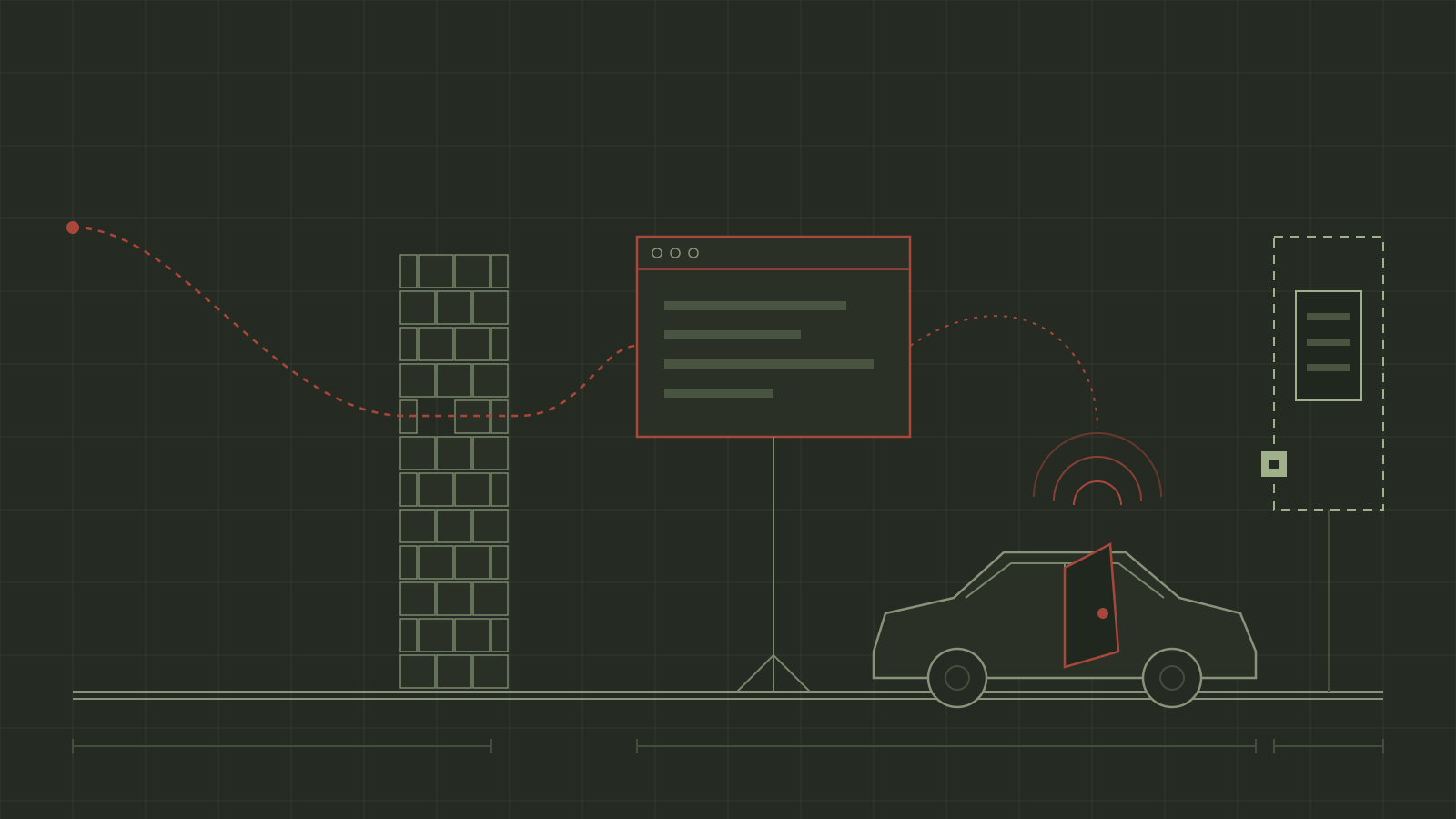
Your car, unlocked remotely
You park your car, lock it and consider it safe. Nobody should be able to unlock it without the key. But in reality, an attacker can give the remote command to unlock your doors and start your motor.
That's what two security researchers just showed for one car brand in Australia and the US.
From a VIN to the owner's account
Let's assume the attacker knows the VIN of the car. The automaker ran a supposedly internal admin page, labeled as a test tool, that actually had access to the production data. It was used to manage customer accounts and real vehicles. And of course, it was reachable from the open internet.
Give it a VIN and it led straight to the owner's account: name, email, mobile number, even their password hashes.
Admin credentials in public code
Now, even worse is the following. The automaker's public web code also contained admin credentials for its identity platform, the system that manages customer logins. Those credentials were hard-coded inside the front-end code sent to every visitor.
An AI gets around the firewall
Naive login attempts with the admin credentials did not work, due to a firewall. But an agentic AI found a special way to construct the URL to bypass that filter.
Taking over the car
Then, with the admin access, the researchers could override an owner's password, skip two-factor authentication, and finally send commands to the vehicle. The researchers unlocked cars they owned or had permission to use, to prove that it works in practice.
How it could have been prevented
How can you prevent these attacks? If applied properly, the zone integrity standard could have prevented these issues.
Start with the VIN lookup. A public identifier must never lead to a private record.
The admin tool belonged behind a private network, in its dedicated zone, reachable only by staff.
Then the admin credentials. Secrets that give access to a zone are not supposed to be made public.
Monitoring zones inside and out
That's why we recommend monitoring zones both internally, to see if a zone has been compromised already, and externally, to see if one of the access tokens leading into it has been compromised.
Remote control of doors and engines needs strong security checks.
Mapping zones and gateways
The mix-up between test tools and real production data could have been discovered by carefully mapping the infrastructure to dedicated security zones. The gateway that allowed two-factor authentication to be skipped would have been flagged and fixed.
Firewalls, AI and red teaming
And a firewall alone may not be a security boundary at all, if AI is smart enough to find a way around it. That's why red teaming is mandatory in the zone integrity standard.
Questions for your company
Now let's talk about your company. Who checks whether any of your vendors has an additional route into your systems? Who makes sure a test tool never ends up connecting the open internet to production data?
Those questions can be answered by a cybersecurity authority that acts on your behalf. And that is the mission of ZebraZones. In a world where AI agents can probe your systems around the clock, you need a cybersecurity partner on your side.
References
Sources & further reading
- 01Shubham Shah, “Unlocking any car from X brand in most of the world”
- 02Sam Curry, “Hacking Two Automakers: ForgeRock Path Confusion, RCE, and Remote Vehicle Access”
- 03iTnews, “Admin creds left in carmaker app opened doors to vehicles”
- 04Infosecurity Magazine, “Default Admin Password Let Researchers Unlock and Start Cars”